/ Stars that died in 2023

Monday, January 6, 2014

Andrew Geller, American architect, died from kidney failure he was 87.

Andrew Michael Geller  was an American architect, painter and graphic designer widely known for his uninhibited, sculptural beach houses in the coastal regions of New York, New Jersey and Connecticut during the 1950s and 60s—and for his indirect role in the 1959 Kitchen Debate between Richard Nixon (then Vice President) and Soviet Premier Nikita Khrushchev, which began at an exhibit Geller had helped design for the American National Exhibition in Moscow died from kidney failure he was 87..
Lord and Taylor.svg
Geller worked with the prominent firm of American industrial and graphic designer Raymond Loewy where his projects ranged widely—from the design of shopping centers and department stores across the United States, to the Windows on the World restaurant atop the World Trade Center[1] and the logo of New York-based department store Lord and Taylor[1][2]
After designing a beach house for Loewy's director of public relations,[3] Geller was featured in the New York Times and began receiving notoriety for his own work. Between 1955 and 1974,[4] Geller produced a series of modest but distinctive vacation homes, many published in popular magazines including Life, Sports Illustrated, and Esquire.[3]
On his death in 2011, the New York Times said Geller "helped bring modernism to the masses." [5]

Background

It’s one of the first
lessons I ever was taught.
The thing you produce ought
to be compatible with what’s there.
It should live with it both in
scale and some sort of human factor.
– Andrew Geller [6]

Geller was born in Brooklyn on April 17, 1924 to Olga and Joseph Geller, an artist and sign painter who had emigrated from Hungary in 1905.[7] Architectural historian Alastair Gordon reported that as a sign painter Joseph Geller designed the logo for Boar's Head Provision Company, still in use today.[3]
Geller studied drawing with his father,[3] and the attended art classes at the Brooklyn Museum. A 1938 painted self-portrait won him a scholarship to the New York High School of Art and Music (1939),[3] and he subsequently studied architecture at Cooper Union,[5] where he took drawing class with Robert Gwathmey, father of architect Charles Gwathmey.[3] Geller later worked as a naval architect for the United States Maritime Commission designing tanker hulls and interiors (1939–42).
During World War II, Geller served in the U.S. Army Corps of Engineers (1942–45) and was inadvertently exposed to a toxic chemical agent, suffering medical consequences for the remainder of his life.[3] Geller married Shirley Morris (a painter)[8] in 1944. The couple lived in Northport, New York and together had a son, Gregg Geller (formerly catalog executive at RCA, CBS and Warner Bros.)[9] and a daughter, Jamie Geller Dutra[5] (formerly interior designer at Loewy/Snaith).[10]
Prior to his death in December 2011 in Syracuse, Geller lived in Spencer, New York.[5]

Career with Loewy

After reading in Life magazine of Raymond Loewy's diverse and comprehensive career,[3] Geller began what became a career (variously reported as 28[8] or 35[11] years) at Raymond Loewy Associates — later known as Raymond Loewy/William Snaith Inc. or simply Loewy/Snaith.
Geller went on to carry various titles at Loewy/Snaith, including 'head of the New York City architecture department', 'vice president' and 'director of design,'[8] — working on notable projects including the interiors and garden (with Isamu Noguchi) for the glass-and-metal Lever House.[7] At Loewy/Snaith, Geller also designed shopping centers and department stores across the United States,[7] notably for Macy's, Lord & Taylor, Wanamaker's, Bloomingdales, Apex Department Stores[12] and Daytons — as well as work for Bell Telephone, and the Worlds Fair Beirut U.S. Pavilion (year unknown).
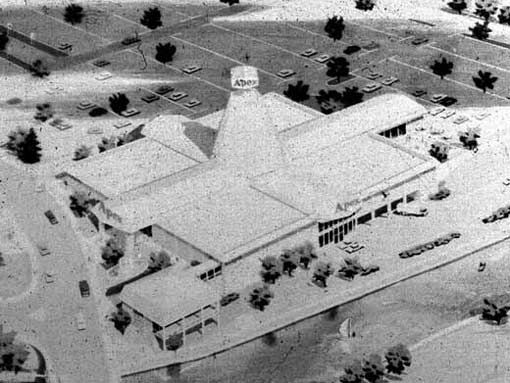
See: Rendering for Apex Department Stores, Pawtucket, Rhode Island, Andrew Geller
Geller left Loewy/Snaith in 1976. It has been reported that at some point in his career, Geller designed the Quiet House for a Dallas, Texas consortium, the all-aluminum Easy Care Home for the Aluminum Association of America, and the Vacation House System.[3]
In 2009, the city of Stamford, Connecticut listed the 150,000 square foot Lord & Taylor at 110 High Ridge Road on the state's list of landmark buildings — after the building had been inadvertently made more prominent by the razing of adjacent trees.[13] Geller had designed the three-story building in 1969 while with Loewy/Snaith.[14] Richard Longstreth, director of the Graduate Program in Historic Preservation at George Washington University, said the store's case for preservation was “quite straightforward, based on the significance of the company it has housed, the nature of its siting, the firm that designed the building, and as a now rare survivor of its type."[15]
See: Lord & Taylor, Stamford, CT, 1969, Andrew Geller
See: Rendering, Lord & Taylor, Stamford, CT, Andrew Geller

Kitchen Debate and Leisurama

In 1959, as vice president of the Housing and Home Components department at Loewy/Snaith, Geller was the design supervisor for the exhibition, the "Typical American House," built at the American National Exhibition in Moscow. The exhibition home largely replicated a home previously built at 398 Townline Road[16] in Commack, New York, which had been originally designed by Stanley H. Klein for a Long Island-based firm, All-State Properties (later known as Sadkin enterprises),[17] headed by developer Herbert Sadkin.[18][19] To accommodate visitors to the exhibition, Sadkin hired Loewy's office to modify Klein's floor plan.[16] Geller supervised the work, which "split" the house, creating a way for large numbers of visitors to tour the small house[16] and giving rise to its nickname, Splitnik.[16]
See: Geller's "split" home at the American National Exhibition
See: 398 Townline Road, Commack, New York, designed by Stanley H. Klein
40°51′40.02″N 73°17′25.77″E
Subsequently, Richard Nixon (then Vice President) and Soviet Premier Nikita Khrushchev on July 24, 1959 began what became known as the Kitchen Debate — a debate over the merits of capitalism vs. socialism, with Khrushchev saying Americans could not afford the luxury represented by the "Typical American House".[7] Tass, the Soviet news agency said: "There is no more truth in showing this as the typical home of the American worker than, say, in showing the Taj Mahal as the typical home of a Bombay textile worker."[16]
The temporary 'Typical American House' exhibit was demolished, and the developer hired William Safire as the company's marketing agent.[16] All-State later hired Loewy and Geller to design Leisurama, homes marketed at Macy's and built on Long Island — leveraging the press coverage from the Russian exhibition.[16]

Solo career

Geller became known for a number of homes in New England that he designed while moonlighting at Loewy/Snaith,[3] with the encouragement of Loewy and Snaith.[8] The houses each had an abstract sculptural quality; a 1999 New York Times article called the homes "eccentrically free-form and eye-grabbing."[7] Another article called the homes "ingenious wooden spacecraft."[20] Another described the houses as "quirky, tiny, site-specific."[8] Geller himself gave the houses nicknames such as the Butterfly, the Box Kite, Milk Carton and Grasshopper.[3]
Geller's work met a varied reception. Mark Lamster, writing for Design Observer, described Geller's Long Island house designs as "inexpensive and modest homes with playful shapes that radiated a sense of post-war optimism."[21] His 1966 design for the Elkin House in Sagaponack, New York, which he called Reclining Picasso was described as "an angular mess" in a 2001 New York Times book review.[22]
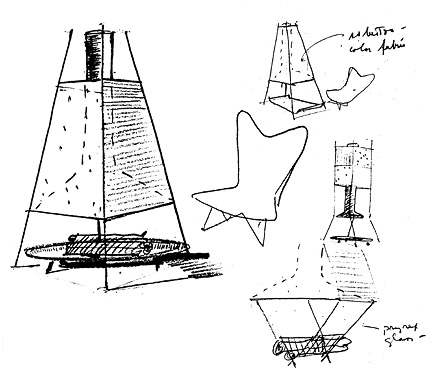
See: Andrew Geller design sketch
Examples of Geller's idiosyncratic home designs include the 1955 Reese House for Elizabeth Reese in Sagaponack, New York[3] — an A-Frame house that popularized the construction method after it was featured appeared on the cover of the New York Times as well as in the newspaper's real estate section of the May 5, 1957 edition. Reese, the client, was at the time the director of public relations at Loewy's office, and she publicized Geller's work — with John Callahan of the New York Times writing several articles on his work.[3]
The Pearlroth House in Westhampton, of 1959, consists of a pair of diamond-shaped structures.[23] When the 600square foot Pearlroth home was slated for demolition in 2006, it was called an "icon of Modernism."[24] The house — which featured two boxes rotated 45 degrees in a distinctive shape — was eventually relocated to be restored as a public museum.[24] Architectural historian Alastair Gordon said the house "is one of the most important examples of experimental design built during the postwar period – not just on Long Island but anywhere in the United States. It is witty, bold and inventive."
In 1958, Geller designed a beach house for bachelors. The Esquire Weekend House could be delivered to any location to be constructed on stilts.[3] Alastair Gordan, architectural historian, called the one-room house a "reducto ad absurdum version of the post-war weekend aesthetic."[3]
See: The Esquire Weekend House, rendering by Andrew Geller

Publicity

Geller's architectural designs on Long Island were featured in a 1999 exhibition called Weekend Utopia: The Modern Beach House on Eastern Long Island, 1960–1973, at the Guild Hall Museum in East Hampton, New York[20] — and in 2005 at an exhibit entitled Imagination: The Art and Architecture of Andrew Geller at New York's Municipal Art Society.[25]
Geller's grandson, Jake Gorst, wrote, produced and directed a 2005[26] documentary about his grandfather's work on the Leisurama homes. Since 2011, Gorst has actively sought to preserve the archives of Geller's works, including drawings, models and film recordings[27] — having used Kickstarter to help finance the archival work.
Geller's Long Island Homes were subject of the 2003 book Beach Houses: Andrew Geller. The Macy's homes were the subject of the 2008 book Leisurama Now: The Beach House for Everyone, by Paul Sahre. In 2001, his Pearlroth house was named one of the "10 Best Houses in the Hamptons."[28]


To see more of who died in 2011 click here

Jack Fulbeck, American poet and academic, died he was 95.

John Frederick "Jack" Fulbeck was an American poet and professor of comparative literature at the California State Polytechnic University, Pomona died he was 95.. [1] 
(December 19, 1916 – December 25, 2011) 
He served two terms as president of the California State Poetry Society. [2] His poems have won numerous awards, such as "Apostrophe to Amour" and "Introspection in the Cold" which won first prizes in California state level poetry contests, and "In Fuente Vaqueros" which won an international grand prize. His poem "Challengers" was read by Taylor Wang from the orbiting Space Shuttle Challenger in 1985 and is on record at the National Archives Building.[3] He authored three books of poetry: I Sleep With Strangers, Gilgamesh, and Sifted Ashes.
Fulbeck was born in New York City and raised in Bloomfield, New Jersey. He attended Tusculum College in Tennessee on a New Jersey State Scholarship. Following the bombing of Pearl Harbor, he enlisted in the United States Navy and was stationed as a fighter pilot in the South Pacific. After the end of World War II, he worked as a newspaper and magazine editor and a freelance writer. In 1960, Fulbeck received his Ph.D. in Comparative Literature from the University of Southern California and married Seckyue Mary Chan and adopted her two children, Josephine and David. His third child, Kip Fulbeck, was born in 1965.[3]


To see more of who died in 2011 click here

Satyadev Dubey, Indian actor, playwright and director, died he was 75.

Satyadev Dubey was an Indian theatre director, actor, playwright, screenwriter, and film actor and director  died he was 75.. He was awarded the Sangeet Natak Akademi Award in 1971.[2]
He won the 1978 National Film Award for Best Screenplay for Shyam Benegal's Bhumika and 1980 Filmfare Best Dialogue Award for Junoon. In 2011, he was honoured with the Padma Bhushan by the Government of India.

(1936 –25 December 2011)

Biography

Satyadev Dubey was born in Bilaspur district of the then Madhya Pradesh in 1936. He moved to Mumbai with the aim of becoming a cricketer, but ended up joining the Theatre Unit, a theatre group run by Ebrahim Alkazi, which also ran a school for many budding artists. Later when Alkazi left for Delhi to head the National School of Drama, he took over the Theatre Unit, and went on to produce many important plays in the Indian theatre.
He produced Girish Karnad's first play Yayati, and also his noted play Hayavadana, Badal Sarkar's Ebang Indrajit and Pagla Ghoda, Chandrashekhara Kambara’s Aur Tota Bola (Jokumaraswamy in original Kannada), Mohan Rakesh’s Aadhe Adhure, Vijay Tendulkar’s Khamosh! Adalat Jaari Hai, and A Raincoat For All Occasions and Jean Anouilh's Antigone in 2007.
He is credited with the discovery of Dharmavir Bharati’s Andha Yug, a play that was written for radio; Dubey saw its potential, sent it across to Ebrahim Alkazi at National School of Drama, and the rest is history, in modern Indian theatre. Wwhen staged in 1962, Andha Yug brought in a new paradigm in Indian theatre of the times.[3][4]
He made two short films Aparichay ke Vindhachal (1965) and Tongue In Cheek (1968),[5] and directed a Marathi feature film, Shantata! Court Chalu Aahe (1971), based on Vijay Tendulkar's play, which in turn is based on Friedrich Dürrenmatt's story "Die Panne".

Filmography


To see more of who died in 2011 click here

Adrienne Cooper, American klezmer and Yiddish vocalist, died from adrenal cancer she was 65.

Adrienne Khana Cooper  was a Yiddish singer, musician and activist[1][2] who was integral to the contemporary revival of klezmer music  died from adrenal cancer she was 65..[3][4]


(September 1, 1946 – December 25, 2011)


In addition to her work as a Yiddish singer she was the assistant director at the YIVO Institute for Jewish Research, program director for the Museum of Chinese in the Americas, and executive officer for programming and executive officer for external affairs for the Workmen's Circle.[5][6] She co-founded KlezKamp.[7] She was a member of Jews for Racial and Economic Justice's Board of Directors until the summer of 2011, when she was diagnosed with cancer. Cooper won the Rabbi Marshall T. Meyer Risk Taker Award from the Jews for Racial and Economic Justice in 2010, as well as KlezKanada's Lifetime Achievement Award in Yiddish Arts and Culture.[8][9]
She died of adrenal cancer[10][11] at Roosevelt Hospital in Manhattan on December 25, 2011, aged 65.[12][13] She had been diagnosed in July 2011[14] and underwent surgery in August 2011.
Cooper is survived by her daughter, Sarah Mina Gordon, a vocalist and co-leader of the band "Yiddish Princess", as well as her mother, two brothers, and her partner, Marilyn Lerner, a pianist-composer.[15]
A memorial service was held on the morning of December 28, 2011, at Congregation B'nai Shalom in Walnut Creek, California. The service was followed by a graveside funeral at Oakmont Cemetery in Lafayette, California. A memorial service in New York City was held[16] on January 1, 2012 at Congregation Ansche Chesed. Shiva was held at Cooper's daughter's apartment in New York City.[17][18]
A Kholem/Dreaming in Yiddish, A Concert in Tribute to Adrienne Cooper has been organized for December 22, 2012, at the Kaye Playhouse at Hunter College in New York CIty. More than 50 Yiddish and klezmer musicians and global colleagues are slated to perform songs that Adrienne taught, sang, and recorded – these include the Klezmatics, Michael Wex, Shura Lipovsky, Dan Kahn, Theresa Tova, Zalmen Mlotek, Eleanor Reissa, Wolf Krakowski, Michael Alpert, Michael Winograd, Sarah Gordon.[19]

Discography

Solo Recordings

  • Enchanted (2010)[20]
  • Ghetto Tango (2000)[21]
  • Dreaming in Yiddish (1995)[22]


To see more of who died in 2011 click here

Sue Carroll, British journalist, died from pancreatic cancer she was 58.

Susan Elizabeth "Sue" Carroll was an English journalist, best known for her time as a columnist at the Daily Mirror  died from pancreatic cancer she was 58..


(6 December 1953 – 25 December 2011) 

Career

Carroll was born in 1953 at Gosforth, Newcastle-upon-Tyne.[1] After leaving Gosforth Grammar School she joined D. C. Thomson & Co. in Dundee, Scotland. Working on the weekly teenage girls magazine Jackie she assisted on its "Cathy and Claire" problem page and then moved on to write the magazines fashion and beauty features. Aged 20 she moved to London to work as features editor for Woman.
Employed for her ability to extract private information from celebrities in interviews, she moved to the News Of The World, where she was later involved in the launch of its Sunday magazine. Moving to sister paper The Sun as Women's editor and than as a features writer, she acted as a mentor to the assistant writer of the newspapers A-Z of Soaps column, Rebekah Wade.[1]
Carroll joined the Daily Mirror in 1998,[1] writing under the banner "Warm, witty and straight to the point... Britain's best columnist". Her first column began:
"I smoke, I drink, I eat red meat by the pound and I don't like being told what to do by bullies."
Over time, her column featured her thoughts on society, values, popular culture and celebrity.[2] She displayed a consistent ability to provoke, and in 2002 during supermodel Naomi Campbell's privacy case against the Daily Mirror, judge Mr Justice Morland described Carroll's reference to Campbell as a "chocolate soldier" as "extremely rude and offensive".[1] She was described by Kevin Maguire, an associate editor at the Daily Mirror, as "the queen of columnists".[3]

Later life

Carroll was diagnosed as having pancreatic cancer in July 2010, writing a column in March 2011 she explained her condition.[4] After undergoing a failed operation, she underwent chemotherapy treatment at the Royal Marsden Hospital.[1]
In September 2010 she suffered a stroke, and after recovery two months later attended the Daily Mirror's Pride of Britain Awards, in a wheelchair pushed by comedian Paul O'Grady (aka Lily Savage).[1]
She died at her London home on 25 December 2011, aged 58.[5][6]


To see more of who died in 2011 click here

Ben Breedlove, American Internet personality, died from cardiac arrest he was 18.

Benjamin Daniel Breedlove [2] was an American Internet personality from Austin, Texas, known for his blogs on YouTube .[2][3] On the night of December 25, 2011, he died of cardiac arrest at the age of 18.[2][4]


(August 8, 1993 – December 25, 2011)


Personal life

Breedlove grew up in Austin, Texas, where he was a senior at Westlake High School. He lived with his parents and two siblings, older sister Ally and younger brother Jake.[1][4] In 2010, he began making video blogs on YouTube, in which he dealt out relationship advice to his peers.[4]

YouTube

Breedlove created the OurAdvice4You channel on YouTube in November 2010 with friends, Justin Miller and Megan Parken.[2][3][5] He would give out relationship advice to his viewers and interview family members and friends. On May 23, 2011, he launched his second channel, BreedloveTV, a companion channel to his first, where he would answer questions about dating, relationships and advice.[2] According to family members, girls from all over the world would message Breedlove, asking him for advice. In his hometown, Breedlove became a celebrity to many teenagers; he was continually asked to be in pictures with his fans.[6]
As of 2 September 2012, OurAdvice4You has a total of 38 videos, and more than 60,000 subscribers, and BreedloveTV has 17 videos and over 32,000 subscribers.
A third channel was created by Breedlove on December 18, 2011, entitled TotalRandomness512. This channel is the host of the two-part video, "This is my story", which has since become viral. As of 27 December 2012, both videos have a total of 12.6 million views.[2]

Heart condition

At an early age, Breedlove had been diagnosed with hypertrophic cardiomyopathy, a muscle heart disease which made it difficult for his heart to pump blood, ultimately leading to cardiac issues. His doctor believed that Breedlove would not survive past his early teenage years.[1]

"This is my story"

On December 18, 2011, Breedlove released a 2-part video on YouTube, entitled "This is my story." Breedlove opens up about his heart condition as well as the impact it had on his life, using note cards. He also mentioned three near-death experiences.[7]
"I was at school, walking in the hall. I could tell I was going to faint, so I sat on a bench. I passed out. The next thing I know, I woke up with EMS around me. I couldn't talk or move, I could only watch what they were doing. They put the shock pads on my chest. I heard one of them say 'They are ready'. And the other guy said 'Go!'. I passed out again. My heart stopped and I wasn't breathing for 3 minutes."
Breedlove on the third time he "cheated death".[8]

Breedlove in September 2011.
In the video, Breedlove describes the first time he "cheated" death, which was at the age of 4 when he had a life-threatening seizure.[7] He goes on to describe an experience he had in a hospital while being wheeled on a stretcher, "There was this big bright light above me ... I couldn't make out what it was because it was so bright. I told my mom, 'Look at the bright light' and pointed up. She said she didn't see anything."[2][4][8]
On May 5, 2009, Breedlove underwent surgery to insert a pacemaker.[2] The pacemaker helped regulate his heart rhythm and gave him more energy.[1] In the video he shows a red scar on his chest, where the pacemaker had been inserted.[8]
In the summer of 2011, while in the hospital for a routine tonsillectomy, Breedlove suffered his second cardiac arrest. He stated that, "It was a miracle that they brought me back ... I was scared to die, but am SO glad I didn't."[2]
The third time Breedlove survived death was on December 6, 2011. While in the hall at Westlake High School, he felt that he was going to faint, so he sat on a bench and lost consciousness. The next thing he remembered was being surrounded by emergency medical services (EMS) personnel, and that he was unable to speak or move. He remembers passing out a second time right before he was about to be resuscitated with a "shock pad". During this time his heart ceased pumping blood for three minutes.[8][9] While unconscious, Breedlove had a feeling of comfort similar to that of his first near-death experience. He recalls being dressed up in a white suit while standing alongside his favorite rapper, Kid Cudi, in a white room.[8] He references Cudi's song "Mr. Rager", citing the track as his favorite song.[10] He asks at the end of the video, "Do you believe in Angels or God?" and simply answers, "I Do."[11]

Death

Breedlove died from a cardiac arrest on the evening of Christmas Day, 2011, at his parents' home as family and friends were gathering for Christmas dinner.[4] According to Ben's school friend, he had received a new video camera for Christmas and was anxious to get outside and try it. While outside, he began experiencing shortness of breath and light headedness. Breedlove laid down in the yard then passed out. His parents called 911 and administered CPR until EMS arrived. Friends of the family were on their way to the Breedlove home to share Christmas dinner with them. However, when they arrived the yard was filled with emergency vehicles. Paramedics rushed Ben to the hospital, but all resuscitation attempts failed.[12]

Aftermath

News of his death made world coverage on December 27, his story first appearing on Australia's Ninemsn[5] before coverage spread out through the world on other major media outlets, including the Los Angeles Times,[8] American Broadcasting Company,[2] CBS News,[13] MSNBC,[9] Fox News,[14] MTV,[15] Daily Mail,[4] The Independent,[16] Herald Sun,[17] Washington Post,[18] People Magazine,[19] and The Wall Street Journal.[20]
On December 29, Breedlove's funeral was held at the Gateway Church, in Austin, Texas. The memorial service was streamed live on the KXAN website, at his father's request. More than 1,400 people attended the service, and another 11,000 watched online.[21][22] A day after Breedlove's death, Kid Cudi said in reaction, "This has really touched my heart in a way I can't describe, this is why I do what I do."[23] Kid Cudi later dedicated his third studio album Indicud (2013), to Breedlove and all his fans that have passed away, in the album's liner notes.[24]
Breedlove's family had his organs and tissue donated, a decision that wasn't difficult, since, Ben eventually would have needed heart transplantation himself, and "Ben would have wanted to continue helping and inspiring others," according to his mother.[25] On January 1, 2013, Breedlove was among four other individuals honored by Dignity Memorial on a Donate Life float at the 124th Tournament of Roses Parade. The float was memorialized with floragraphs and portraits of the five individuals, made out of floral and other natural materials, that were decorated by their family and friends in December.[25][26]

Hypertrophic Cardiomyopathy Association & The HEARTS Act

On January 5, 2012, the HCMA (Hypertrophic Cardiomyopathy Association) announced that they mourn the death of Breedlove and are encouraging their members to "tell their stories the same way as Ben." Lisa Salberg, founder and CEO of HCMA, along with New Jersey Congressman Frank Pallone Jr. had worked together in drafting the Cardiomyopathy Health Education, Awareness, Risk Assessment, and Training in the Schools (HEARTs) act. The Bill was introduced in January 2012 to Congress. "The HEARTs Act mandates raising awareness about Sudden Cardiac Arrest (SCA) in schools and childcare centers and requires better prevention measures that will save young people's lives. It requires the Secretary of Health and Human Services to coordinate with the Centers for Disease Control as well as patient advocacy and health professional organizations to develop and distribute materials about SCA. Also, it requires guidelines regarding the placement of life-saving automated external defibrillators in schools and information on cardiopulmonary resuscitation CPR training."[27]
Salberg cited Ben Breedlove and others like him as the reason they will "lobby hard for the passage" of the HEARTs Act. The HCMA have agreed to create a special design bracelet for awareness of the disease. Students of Ben's high school, Westlake High, have had input into the design.[28]
The Westlake High School Student Council and Friday Night Fan Stand collected donations for the Hypertrophic Cardiomyopathy Association during the Ben Breedlove Memorial Football Game which took place at the Westlake football stadium on September 21, 2012.[29] Fans wore white as a show of support and a moment of silence was observed. Funds collected were used for educational efforts relating to the disease that claimed Breedlove's life.[29]

Africa New Life Ministries

Donations in honor of Breedlove have also been directed to Africa New Life Ministries, an organization which states as its mission to provide "education, spiritual insight and basic necessities to poor children and families."[30] During Breedlove's teenage years, he became familiar with the plight of homeless African children; specifically those enslaved as child soldiers. Breedlove's desire was to find a way to help these children, but he was unable to do so during his lifetime. In honor of Breedlove's wishes, funds donated to the Ben Breedlove Memorial Fund will be used to help feed, clothe and educate young men in Rwanda.[31]

On January 1, 2013, the Rose Bowl Parade float titled "Journeys of the Heart", which was sponsored by Donate Life, featured florographs of Breedlove, along with many other organ and tissue donors and recipients.[32] Each year, Donate Life honors deceased organ, eye and tissue donors nationwide by creating and placing the florographs on the float.[33] The float was decorated with all fresh flowers, plants and seeds. The artistry of the float included sweeping hearts that swirled up very high and low, symbolizing the highs and lows of organ and tissue donation.
Breedlove's heart condition, hypertrophic cardiomyopathy, often requires a heart transplant. Because Breedlove would possibly require a heart transplant, he and his family made the decision to register as donors with the belief that if they were to be a recipient family, they should be willing to be donors, too. Breedlove's legacy of donation currently lives on in approximately 50 people, with the potential to help more.[34]


To see more of who died in 2011 click here

Giorgio Bocca, Italian essayist and journalist, died he was 91.

Giorgio Valentino Bocca  was an Italian essayist and journalist, also known for his participation in the World War II partisan movement  died he was 91..[1]

(28 August 1920 – 25 December 2011)


Biography

Bocca was born in Cuneo, Piedmont, the son of teachers, and studied law. He fought in the Alpini corps during World War II, and befriended Benedetto Dalmastro and Duccio Galimberti. Together with them, after the Armistice with Italy (September 1943), he joined the partisan organization called Giustizia e Libertà, becoming the commander of its 10th Division, fighting together with US and British Armies against the nazi-fascists.
Having begun his press career in Cuneo, Bocca wrote for Giustizia and Libertà's magazine during the post-war period. Later, he worked for the Gazzetta del Popolo, L'Europeo and Il Giorno, analyzing Italian culture and politics. In 1971 he was amongst those who signed a document issued by the magazine L'Espresso against police chief Luigi Calabresi after the death of the anarchist Giuseppe Pinelli, soon after killed by a terrorist group of far left named Lotta Continua. Five years later, Bocca was among the founders of the daily La Repubblica, with which he thenceforth collaborated.
He also wrote several books, in most of which he denounces the social and political problems of Italy. He has repeatedly taken a critical stance against globalization, the foreign policy of U.S. oil corporations and the rise of right-wing political parties allied with Forza Italia led by Silvio Berlusconi.
Bocca died in Milan on 25 December 2011.

Controversy

Most critics of Bocca note that in his major opus, History of the Resistance, a large research on the subject of Italy's Partisan movement between 1943 and 1945, he was very partial to extreme left wing partisans and that he omitted important and grave facts such as the Osoppo Massacre (in which a whole non-communist Partisan unit, the Osoppo Brigade, composed of mostly Catholic or moderate-view guerrillas, was ambushed, trapped and executed by leftist guerrillas from the same division in which Bocca was deployed) and that he omitted most of the aftermath immediately following the Liberation of Italy when former partisans took revenge upon former Fascists and collaborationists in Northern and central Italy, mostly by swift executions, kidnapping and other murderous acts.


To see more of who died in 2011 click here

Vitaly Tseshkovsky, Russian chess Grandmaster, died he was 67.

Vitaly Valerianovich Tseshkovsky was a Russian chess Grandmaster and a former champion of the USSR died he was 67..

(Russian: Виталий Валерьевич Цешковский, September 25, 1944 – December 24, 2011) 

Tseshkovsky (Cieszkowski) was born in Omsk into a Polish family (his noble ancestors lived in Volhynia).
He was awarded the International Master title in 1973 and became an International Grandmaster in 1975.
His best tournament victories include first at Leipzig 1975, Dubna 1976, Yerevan 1980, Banja Luka 1981, Sochi 1981 and Minsk 1982. He was co-winner of the 1978 Soviet Championship (with Mikhail Tal) and winner of the 1986 Championship.[1] He beat some world champions: Vasily Smyslov at the Moscow Spartakiad 1974, Tal at Sochi 1970, and a young Garry Kasparov at the 1978 Soviet Championship. Tseshkovsky himself almost qualified for the World Championship candidates matches when he finished fourth in the 1976 Manila Interzonal, one place lower than was needed to progress to the next stage. At the 27th Chess Olympiad in 1986, he scored 2½/5 as the second reserve board to help the USSR team win the gold medal.[2]
His 6/9 result in St Petersburg, 2004 qualified him to play in the Russian Championship final later in the year, alongside Russia's seven top players and five other qualifiers.[3] In 2010, he tied for 2nd-4th with Algimantas Butnorius and Nikolai Pushkov in the European Seniors’ Rapid Championship.[4]
In the opening, his choice was 1.e4 with the white pieces. With Black he played the Ruy Lopez, Sicilian Defence, Pirc Defence and Modern Defence against 1.e4, and against 1.d4 he most often played the Grünfeld Defence and Benko Gambit.
Tseshkovsky maintained a high standard of chess throughout his career, registering his highest Elo rating of 2600 in October 2005. As a coach, he assisted with the training of many high profile players including Vladimir Kramnik, Bartlomiej Macieja and Boris Savchenko.
He died on 24 December 2011 in Krasnodar.[5]


To see more of who died in 2011 click here

Lynn Samuels, American radio personality, died he was 69.

Lynn Margaret Samuels  was an American radio personality and blogger, based in New York City. She attended Bard College  died he was 69..

(September 2, 1942 – December 24, 2011)

She began her radio career at WBAI in 1979, where in addition to her on-air work she was music director and an engineer and producer.[1] Walter Sabo, in a tribute on the Alex Bennett program (hosted by Richard Bey) on December 27, 2011, stated that Lynn first worked for WOR on Saturdays from 4–6 p.m. "for quite some time".
Samuels was heard on WABC from 1987 until 1992, 1993 until 1997,[2] and 1997[3] until 2002,[4] including two breaks in which she was fired and then rehired. Her third and final dismissal in 2002 was allegedly due to budget cuts.
Samuels was also a call-screener for Matt Drudge. In 2002, she joined WLIE[5] for a brief time before being hired by Sirius in 2003.[6]
From 2003 to 2011, Samuels hosted The Lynn Samuels Show initially from 10:00 a.m. to 1:00 p.m. on the weekends before being moved to the shift from 1:00 p.m. to 3:00 p.m. ET on the Sirius Satellite Radio channel SIRIUS Left. Early in 2011, after SIRIUS Left was folded into Sirius XM Left, Sirius reduced her hours and she began a new weekend talk show on Sirius XM Stars from 10:00 a.m. to 1:00 p.m. on Saturdays and Sundays.[7] She also made television appearances on FOX News, CNN, MSNBC, The Sally Jesse Raphael Show, Geraldo at Large and Politically Incorrect.

Death

Lynn Samuels died on December 24, 2011, aged 69, of a heart attack in her Woodside, New York apartment.[8][9][10][11] She is survived by her sister Judy and two nephews. She is buried in Linden Hills Jewish Cemetery in Ridgewood, Queens, NY[12]


To see more of who died in 2011 click here

Jody Rainwater, American bluegrass musician and radio personality, died from heart disease he was 92.


Jody Rainwater aka Little Jody Rainwater (born Charles Edward Johnson,  was an American bluegrass musician and radio personality died from heart disease he was 92..[1]


(Surry County, North Carolina, 1920 — died Richmond, Virginia, December 24, 2011)


Jody Rainwater was one of thirteen children of M. Wilson and Emma Johnson. He was well known for having played bass with the The Foggy Mountain Boys. An elder brother had taken up guitar, and soon they began playing together as "Chuck and Slim, The Johnson Brothers". They played at reunions and social gatherings around the area. The brothers found themselves in High Point, North Carolina, auditioning for the new radio station WMFR which began broadcasting in 1936. They were offered a regular time slot every Thursday morning. Their father believed farm work should take priority, so they eventually cancelled their weekly show. The next big thing for The Johnson Brothers occurred at the 1937 Fourth of July Horse Show in Kernersville, North Carolina. There the brothers entered a competition for performers and won the award for "Best Individual Entertainers".[citation needed]
Rainwater decided to move to Winston-Salem. For four years he found few opportunities in music. He served in the Marines during World War II. In April 1945 he was discharged from active duty and returned to Winston-Salem, where he found work at an auto dealership. While employed there he met a local musician, Woody Hauser. The two formed the band the Blue Ridge Mountain Boys. In 1946 they helped sign on station WTOB and became a regular part of its programming. While playing for WTOB the band played a few local shows in nearby schools. It was during this time that Charles Johnson became "Little Jody". Clad in baggy pants, suspenders, and old shirts the character that would soon be made famous with Flat and Scruggs was born. Little Jody and Woody played together for almost three years. After a trip with Woody and several friends to the Grand Ole Opry, Jody determined that he would one day play the Opry. After the trip Jody and Woody were offered the chance to play during the intermission of a Bill Monroe road show in Lexington, North Carolina, which is where Rainwater first met Lester Flatt.[citation needed]
In 1948, Jody Rainwater left North Carolina for Roanoke, Virginia where he joined the Blue Star Boys. Later that year he learned that Flatt, Earl Scruggs, and others were leaving the Blue Grass Boys to form the Foggy Mountain Boys. Jody was asked to join them to handle bookings and advertising, but he decided to stay in Roanoke. In 1949 a coal strike devastated the Bristol area's economy and the Foggy Mountain Boys left WCYB for Lexington, Kentucky. WCYB offered the Farm and Fun Time slot to the Blue Star Boys and they took it. This didn't work out well, and at this point Flatt again offered the booking job to Jody, who immediately accepted it.[citation needed]
In addition to booking, Jody joined the group on their Saturday night slot on WVLK's Jamboree as Cedric Rainwater's comedic partner. The comedy duo was a hit and Jody was soon being billed as Cedric's younger brother. Lester Flatt suggested the name Little Jody Rainwater and it really stuck. However, the comedic antics of the Rainwater brothers were short lived. Soon Cedric decided to join Hank Williams' Drifting Cowboys and leave bluegrass. The Foggy Mountain Boys found themselves in need of a bassist. For the next three years Rainwater played an important part in the band's sound and stage presence. He was both booking and playing shows. Working seven days a week up to eighteen hours a day. By May 1952 Jody was "right at a nervous breakdown", and, at the advice of a physician he put in his notice. The band was working in central Virginia at the time and he was offered a job working as a deejay at WSVS. With flexible hours and steady pay Jody jumped at the chance. On June 7, 1952 Rainwater left the Foggy Mountain Boys and began his career in radio.[citation needed]

To see more of who died in 2011 click here

Richard Bessière, French author, died he was 88.

Richard Bessière was a French author of science fiction and espionage novels died he was 88.. His œuvre, particularly abundant, was published primarily by publisher Fleuve Noir.[1] Bessière was one of the leading authors of publisher Fleuve Noir's popular imprints Anticipation and Espionnage
(1923 – 22 December 2011)
Bessière was born and died at Béziers - a year after his death, his home town announced that a street would be named in his honour.[2] His first science fiction series (1951–54) featured the Conquérants de l’Universe [Conquerors Of The Universe], a band of Earthmen led by professor Bénac, the inventor of a spaceship called Meteor, who explore the Solar System. Bessière’s most popular series featured the adventures of American journalist Sydney Gordon, his ditzy wife Margaret, his catastrophe-prone son, Bud, and his scientist friends, Archie and Gloria Brent. The series began with serious tales of alien or extra-dimensional invasions, but eventually took a satirical turn. Bessière's other popular series involved the hard-boiled adventures of Dan Seymour, a futuristic James Bond.
Bessière also made his mark on French science fiction through a number of non-connected novels that featured an original blend of horror and science fiction. Monstrous aliens threatening to take over mankind were featured in Escale chez les Vivants [Stop-Over Among The Living] (1960); evil entities from beyond human ken whose only weakness was sound invaded Earth in Les Maîtres du Silence [The Masters Of Silence] (1965); Cette Lueur Qui Venait Des Ténèbres [That Light Which Came From The Dark] (1967) featured ghastly body-snatching parasites. The ultimately doomed reconquest of a post-cataclysmic Earth ruled by mutants and deadly lifeforms, was the subject of Légion Alpha (1961), Les Sept Anneaux de Rhéa [The Seven Rings Of Rhea] (1962), in which Earth was described as seven concentric spheres with Hell at its core, and Les Jardins de l’Apocalypse [The Gardens Of The Apocalypse] (1963). Les Marteaux de Vulcain [The Hammers Of Vulcan] (1969) described a nightmarish planet where survival was all but impossible.
Bessière also wrote almost a hundred spy thrillers for the Espionnage imprint of Fleuve Noir under the pseudonym of F.-H. Ribes. Many of these starred a hero called Gérard Lecomte.


To see more of who died in 2011 click here

Zsuzsi Mary, Hungarian pop singer, committed suicide she was 64.


Zsuzsa Mary also known as Zsuzsi Mary was a Hungarian pop singer committed suicide she was 64..


(13 October 1947 – 24 December 2011)

Career

She appeared first time on stage in 1965, later she finished on the first place in the Hungarian Television's song contest, the Táncdalfesztivál, with the song "Mama" (Mom) in 1968. The songwriter was Attila Dobos, who would be her first husband. She was successful in the Eastern Bloc countries too. In 1969, she married György Klapka, and soon after emigrated with her husband. They divorced in 1987, but maintained a good relationship. She returned to Hungary after the end of Communism. Mary came out as bisexual in 2008.[2]

Death

She committed suicide on Christmas Eve, 2011, aged 64.[3][4][5] According to Magyar Távirati Iroda (MTI) her body was found the next day, 25 December 2011.[6] Her suicide was confirmed by her second husband, György Klapka.[7]

Albums

  • 1991 - Ez az utolsó tangó (This is the last tango)
  • 2002 - Premier M (My premier)
  • 2005 - Sodor a szél (Drifting in the wind)

Posthomous releases

December 26., 2011 - Elszálltaka az évek (CD Single) (Vanished over the years)
It's as if this song would have she said goodbye.
The refrain:
"Flew off over the years
They do not hurt the silence
The tranquility locking arms
So rock out"


To see more of who died in 2011 click here

Marvin Knopp, American mathematician, died he was 78.


Marvin Isadore Knopp was an American mathematician who worked primarily in number theory died he was 78.. He made notable contributions to the theory of modular forms.

(January 4, 1933 – December 24, 2011) 

Life and education

Knopp was born on 1933 in Chicago, Illinois. He received his PhD under Paul T. Bateman from the University of Illinois in 1958 where he became friends with fellow student Gene Golub.[2] Over the course of his career, he advised twenty Ph.D. students.[3] He is the father of pianist Seth Knopp, and of Yehudah, Abby, and Elana.[4] Marvin was married to Dr. Josephine Zadovsky Knopp for 25 years but the marriage ended in divorce. Knopp died on December 24, 2011 during a vacation in Florida. Marvin's true loves in life were his children, old movies, great music and numbers.

Career

After receiving his PhD in 1958, Knopp taught at the University of Wisconsin and then, for a few years, at the University of Illinois Chicago before moving, in 1976, to Temple University where he stayed until his sudden death in 2011.[5] He was closely associated with Emil Grosswald.[6] In Jean Dieudonne's influential book A Panorama of Pure Mathematics (Academic Press, 1982), he is mentioned (p. 95) as one of those who "made substantial contributions" to the theory of modular forms.

Selected publications

  • Knopp, Marvin (1970). Modular Functions in Analytic Number Theory. : Rand McNally. ISBN 0-528-60000-1.

Further reading

  • American Mathematical Society. Marvin Knopp ..., ed. (1993). In Knopp, Marvin; Sheingorn, Mark. A Tribute to Emil Grosswald. Providence: American Mathematical Society. ISBN 978-0-8218-5155-5. Retrieved 2009-02-06. A set of papers in honor of Grosswald; includes reminiscences, list of PhD students, and a list of papers and books.


To see more of who died in 2011 click here

Dickey Betts died he was 80

Early Career Forrest Richard Betts was also known as Dickey Betts Betts collaborated with  Duane Allman , introducing melodic twin guitar ha...